


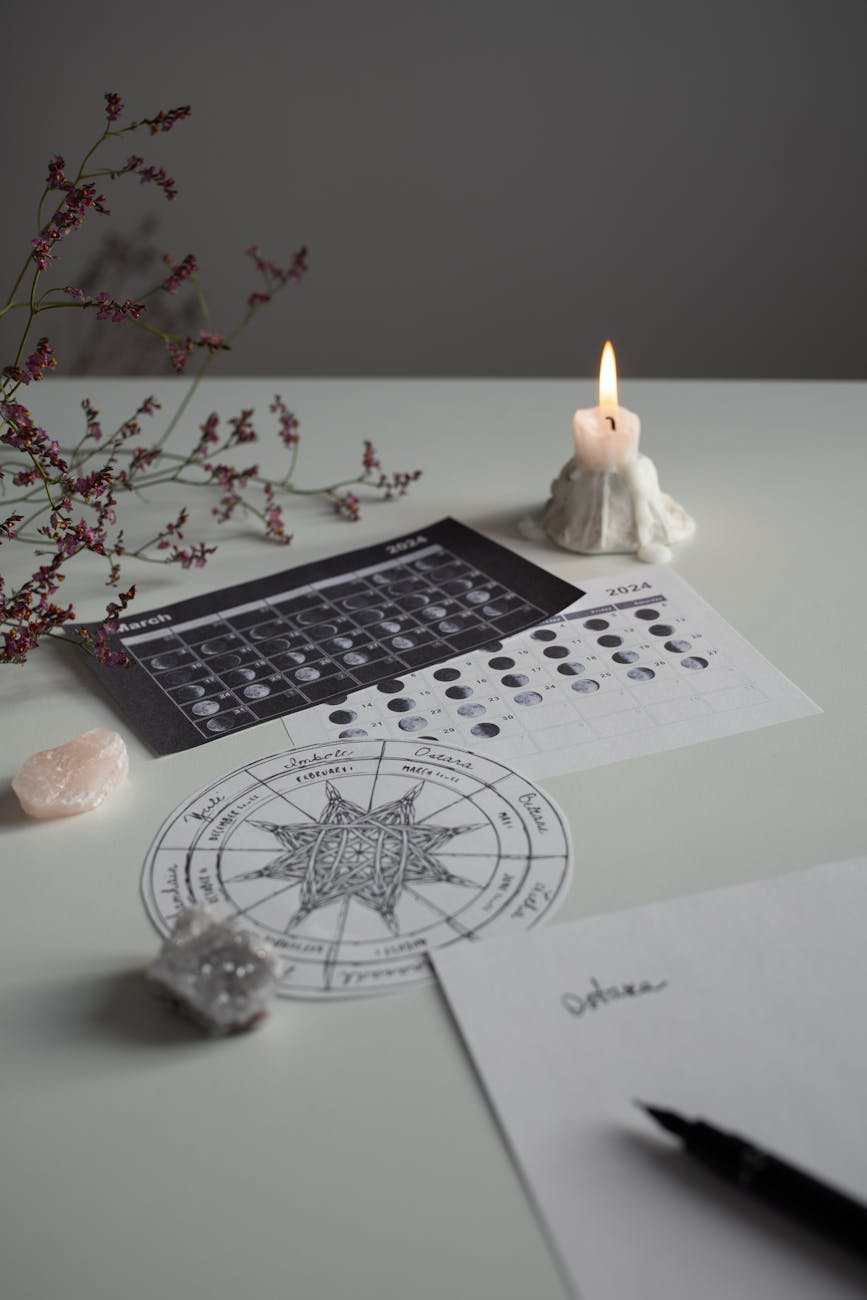
If you’ve ever wondered why Ramadan begins earlier each year, why Chinese New Year sometimes lands in January and other times in February, or why Jewish holidays float within the fall season, you’re already brushing up against the idea of lunar and lunisolar calendars. This guide unpacks what those terms mean in plain language—no astronomy degree required.
What Is a Lunar Calendar?
A lunar calendar measures months by the phases of the Moon—from one new moon to the next. That full cycle, called a synodic month, averages about 29.5 days. Because you can’t have half‑days on a calendar, lunar months are typically 29 or 30 days long.
Add up 12 lunar months and you get about 354 days—roughly 11 days shorter than the 365-day solar year (the time Earth takes to orbit the Sun). That gap is the key reason dates “move” when you compare a lunar calendar to the familiar Gregorian (solar) calendar used for civil life in most of the world.
How the Lunar Cycle Works (The Friendly Version)
Think of the Moon as a mirror reflecting sunlight. As the Earth, Moon, and Sun move, we see different amounts of the Moon’s day side:
- New Moon: The Moon is roughly between Earth and Sun; its bright side faces away from us.
- Waxing Crescent → First Quarter → Waxing Gibbous: We see more lighted surface each night.
- Full Moon: Earth sits between Sun and Moon; the lunar face we see is fully lit.
- Waning Gibbous → Last Quarter → Waning Crescent: The lit portion shrinks until the next new moon.
From one new moon to the next is the synodic month (≈ 29.5 days). In calendars tied to the Moon, the new month starts near the new moon, so the 15th day often lands close to the full moon.
Lunar vs. Solar vs. Lunisolar: What’s the Difference?
Solar calendars (like the Gregorian calendar) track the Sun and the seasons. They keep the length of the year aligned with Earth’s orbit—so June is always northern‑hemisphere summer.
Lunar calendars track the Moon. Twelve lunar months total ~354 days, so without adjustments they drift through the seasons.
Lunisolar calendars are a hybrid: months follow the Moon, and the calendar adds a leap month every so often so that months stay anchored to the seasons. Many lunisolar calendars use patterns similar to the ancient 19-year Metonic cycle, which fits 235 lunar months into 19 solar years remarkably well.
In one line:
- Solar = Sun/season‑based (fixed seasons, months not tied to Moon)
- Lunar = Moon‑based (months match phases; seasons drift)
- Lunisolar = Moon months + occasional leap month to stay in step with the Sun/seasons
Who Uses Which? Cultures, Religions, and Their Holidays
Islamic (Hijri) Calendar — Lunar
The Islamic (Hijri) calendar is a purely lunar system of 12 months, each beginning with the new crescent. Because 12 lunar months are about 11 days shorter than a solar year, Islamic dates shift earlier by about 10–11 days each Gregorian year. That’s why:
- Ramadan (month of fasting) can occur in any season over a 33‑year cycle.
- Eid al‑Fitr (end of Ramadan) and Eid al‑Adha (during the Hajj season) also move accordingly.
Some Muslim communities determine the start of months by local moon‑sighting, while others use astronomical calculations. Both approaches aim to honor the same lunar principle with different methods.
Chinese Calendar — Lunisolar
The traditional Chinese calendar is lunisolar. Months still follow the Moon, but when the calendar starts slipping relative to the seasons, it adds an intercalary (leap) month. As a result:
- Chinese New Year falls on the new moon that begins the first month—usually between late January and mid‑February.
- Mid‑Autumn Festival lands on the 15th day of the 8th month, near the harvest full moon (September/early October).
- Dragon Boat Festival comes on the 5th day of the 5th month (late May/June).
Mainland China (and most places) use the Gregorian calendar for civil life, while festivals and some traditional events follow the lunisolar one.
Hebrew (Jewish) Calendar — Lunisolar
The Hebrew calendar also uses lunar months and adds a leap month seven times in every 19 years to keep festivals in their seasons:
- Passover (15 Nisan) remains a spring festival.
- Rosh Hashanah (1 Tishrei), Yom Kippur (10 Tishrei), and Sukkot (15 Tishrei) cluster in early autumn (September/October).
- Hanukkah (25 Kislev) arrives in late autumn/early winter.
Hindu and Buddhist Traditions — Mostly Lunisolar
South Asia hosts multiple Hindu lunisolar calendars (e.g., Vikram Samvat, Shaka), which may start months at the new moon (amanta) or full moon (purnimanta). An adhika māsa (leap month) is inserted to keep festivals in rhythm with the seasons. Examples:
- Diwali usually falls on the new moon of Kartika (October/November).
- Holi, the festival of colors, comes around the full moon of Phalguna (late February/March).
- Navaratri/Durga Puja aligns with lunar fortnight patterns in autumn.
Many Theravada Buddhist countries (Sri Lanka, Thailand, Myanmar, Laos, Cambodia) also follow lunisolar systems for religious observances:
- Vesak (Buddha’s Birthday, Enlightenment, and Parinirvana observance) is marked on a full moon in April/May, depending on local tradition.
Respect note: Within each tradition, regional practice varies. Communities may observe dates on different days because of time zones, astronomical criteria, or local religious authorities. That diversity is a feature, not a bug.
Why Do Lunar‑Calendar Dates Shift in the Gregorian Calendar?
The math behind the movement
- Solar (Gregorian) year: ≈ 365.24 days
- 12 lunar months: ≈ 354 days
In a pure lunar calendar, the ~11‑day difference means holidays happen about 10–11 days earlier each year on the Gregorian calendar. After roughly 33 years, those dates have completed a full seasonal loop.
In lunisolar systems, the calendar inserts a leap month when needed. That keeps holidays within a seasonal window, but their Gregorian dates still vary:
- Chinese New Year moves within late Jan–mid Feb.
- Passover stays in spring, but the exact Gregorian date shifts annually.
- Diwali clusters around Oct/Nov, with year‑to‑year variation.
Other reasons for slight shifts
- Time zones: A new moon may occur late at night in one country but the next day in another.
- Observation vs. calculation: Some traditions rely on sighted crescents, others on predicted visibility or astronomical new moon definitions.
- Local rulings: Religious councils may set calendars in advance or decide near the date, especially for Islamic months.
Common Misconceptions (and the Reality)
“The Chinese calendar is purely lunar.”
Not quite. It’s lunisolar—months follow the Moon, but a leap month keeps festivals tied to the seasons.
“Lunar calendars are inaccurate.”
They’re accurate for what they measure—the Moon’s phases. If you expect them to match the Sun’s seasons without adjustment, you’ll see “drift”—but that’s by design. Lunisolar systems offset this with intercalation (leap months).
“Ramadan is always in summer (or winter).”
Over three decades or so, Ramadan cycles through every season because the Hijri year is shorter. That’s why fasting sometimes falls in long summer days and other times in cooler months.
“The full moon is always on the 15th day.”
Often—but not always. Time zones and subtle astronomical timing can shift which civil date carries the exact full moon. Some calendars also begin months based on local crescents, which can nudge dates by a day.
“Supermoons change human behavior.”
“Supermoon” simply means a full moon near the Moon’s closest point to Earth (perigee). It looks a bit larger and brighter, and tides can be slightly higher—but beyond that, everyday effects are minimal.
“Blue moon” is an ancient lunar-calendar rule.”
“Blue moon” is a modern phrase for an extra full moon in a season or month. It’s not part of traditional lunar or lunisolar calendar structure.
Why Understanding the Lunar Calendar Still Matters
1) Cultural literacy and respect
Knowing that some holidays float in the Gregorian year helps us respect observances around us—whether that’s a colleague adjusting work hours for Ramadan, neighbors celebrating Diwali, or families gathering for Chinese New Year.
2) Better planning (schools, workplaces, events)
- HR & schools: Inclusive calendars help avoid major exams or deadlines on significant religious dates.
- Event planners: Venue demand surges around popular festivals; booking early saves stress.
- Travelers: Expect crowded trains, ferries, and flights around festivals like Chunyun (the mass migration for Chinese New Year) or Undas (All Saints’/Souls’ Day in the Philippines—an example of a solar‑dated, culturally significant period).
3) Technology and calendars
Most phone and web calendars let you overlay lunar or religious calendars, or subscribe to holiday feeds. For Islamic observances, you may see tentative dates with a note that moon‑sighting could shift them by a day.
4) Sky‑appreciation
Following a lunar or lunisolar calendar is a great excuse to look up. Planning a picnic on a full‑moon weekend, or catching a crescent at dusk, can reconnect you with the rhythms that guided humanity for millennia.
Quick Starter Tips for Using Lunar/Lunisolar Dates
- Add a calendar layer: In your phone’s calendar app, enable Chinese, Hebrew, or Islamic calendars, or subscribe to regional Hindu/Buddhist holiday feeds if available.
- Check local announcements: For Islamic months, confirm with your local mosque or trusted community organization—especially for Ramadan and Eid.
- Know the windows:
- Chinese New Year: late Jan–mid Feb
- Passover: spring (Mar/Apr)
- Diwali: Oct/Nov
- Vesak: Apr/May
This helps you plan even before exact dates are posted.
- Expect nuance: Differences of one day happen. That’s normal when timing hinges on astronomy and local practice.
Final Thought
Lunar and lunisolar calendars aren’t quirky alternatives to the “real” calendar—they’re elegant systems tuned to a different, equally natural beat. Understanding that beat helps us plan better, show respect, and savor traditions that light up our calendar—and our night skies.